News

Gemini Generated Image rrkatlrrkatlrrkasm
News

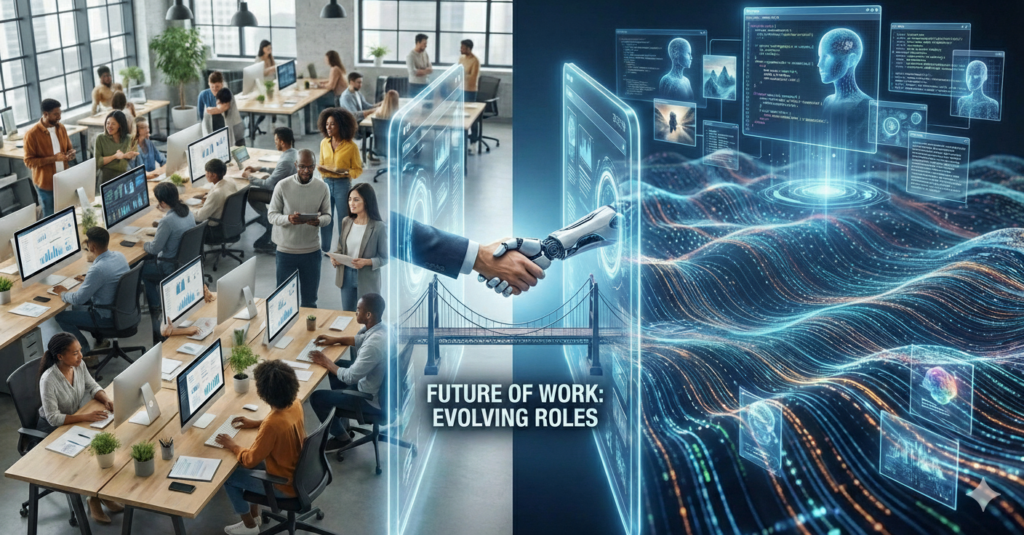
AI Is Rewriting the Workplace — But Not the Way Leaders Think

Performance often improves at first. Errors decline. Processes tighten. On paper, things look better. But underneath, something else is happening. People stop interpreting. They stop arguing. They stop standing behind decisions in the same way.

When hesitation is punished and speed is celebrated, people adapt. They comply. They let the system decide. From the outside, this looks like alignment. From the inside, it feels like erosion.
Gemini Generated Image bb3k99bb3k99bb3ksm
News

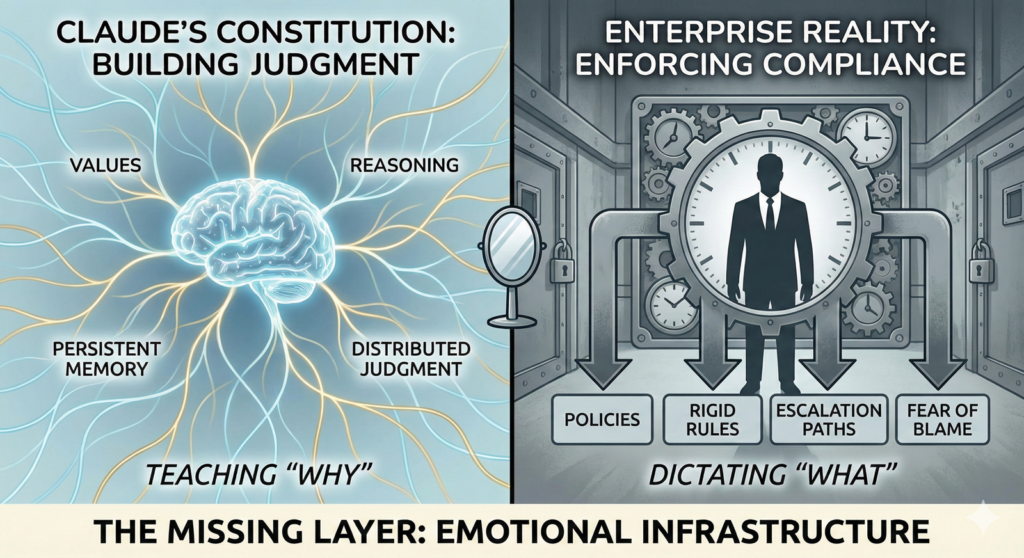
Anthropic Is Building for Claude What Most Companies Refuse to Build for Humans

While Anthropic is building a “constitution” to teach Claude how to reason, navigate ambiguity, and internalize values, most enterprises are doing the exact opposite for their people. We strip away human judgment in favor of rigid compliance, then wonder why execution stalls. This article explores the uncomfortable truth: Anthropic is building the very infrastructure for AI—shared memory and psychological safety—that most companies have refused to build for their own employees for decades.

hintonsm
News

What Hinton Is Warning Us About — and What Comes Before It

Work becomes execution without authorship. … This is not yet unemployment. It is pre-unemployment.

It is the phase where humans are still present, still productive, but no longer fully inhabiting their role as interpreters of reality. And once that interior shift occurs, economic displacement becomes far easier to justify, automate, and absorb.

Gemini Generated Image ioowvkioowvkioow
News

Why Snowflake’s “AI + Data Predictions 2026” Signals the Real Shift in the Age of Intelligence

Snowflake predicts a shift to Agentic AI—autonomous systems—becoming the enterprise infrastructure.

Value: Moves from tools to agentic ecosystems.

Architecture: Requires a unified AI-Data Cloud.

Human Role: Shifts to governance and interpretation.
The Bottom Line: Success in 2026 depends on adapting culture to cohere machine-generated insights.
Successful companies prioritize psychological safety, coherence, and strong leadership over just the best models.
The “AI value gap” is really a coherence gap, meaning the next revolution will be human, not just technological.

Gemini Generated Image gqzwmbgqzwmbgqzw
News

New BCG Survey “The Widening AI Value Gap”

Only 5% of companies capture substantial value from AI. While failures often look technical, the true barrier is a lack of “emotional architecture” and culture.

Successful companies prioritize psychological safety, coherence, and strong leadership over just the best models.
The “AI value gap” is really a coherence gap, meaning the next revolution will be human, not just technological.

Gemini Generated Image l82agpl82agpl82a
News

McKinsey Global Survey “The State of AI in 2025”

AI use is widespread (88% of organizations) but largely in pilot phases. Only a small fraction of “AI high performers” are realizing significant value by using AI for transformation, not just efficiency. Key to their success is redesigning workflows, having strong senior leader commitment, and integrating human judgment (“human in the loop”). Differing expectations remain on the total impact on workforce size.

Gemini Generated Image 8o3aen8o3aen8o3a
News

Generative AI and jobs: A 2025 update (ILO Report)

The article summarizes an ILO report on Generative AI’s impact on jobs, highlighting that:

Clerical jobs are the most exposed, leading to task restructuring rather than elimination.

Women have a significantly higher exposure due to their concentration in clerical roles.

GenAI “hollows out roles,” increasing the importance of human-centric skills and emotional labor.

Vulnerability is higher in low-income countries due to a lack of reskilling infrastructure.
The ILO recommends reskilling, AI literacy, and human-centered job design.

Gemini Generated Image 5edzlp5edzlp5edz
News

E&Y Agentic AI Workplace Survey Results

“While the workforce is enthusiastic about Agentic AI, organizations are struggling to convert this optimism into value. A majority of desk workers feel overwhelmed by the pace of adoption, and leadership gaps in communication and training are causing resistance. Consequently, companies are missing up to 40% of potential AI productivity gains due to a fundamental failure to address the human side of adoption.”

Scroll to Top