
The Seven Patterns Silently Destroying
Your Culture
The Seven Patterns Silently Destroying
Your Culture
“Most cultures don't collapse dramatically. They erode through patterns that go unnoticed, unmeasured, and untreated. By the time leaders feel the disengagement, the damage is already structural.”
A diagnostic framework for leaders who sense something is wrong—but can't name it
The CEO couldn't pinpoint when it started.
There was no crisis. No scandal. No mass exodus. Engagement scores were acceptable. Strategy documents looked polished. Productivity metrics held steady.
But something had shifted.
"It's like we're productive on the surface, but something underneath is breaking," she told us. "I can feel it, but I can't name it."
What she was experiencing is cultural fracture—the invisible erosion that happens when organizations move faster than their emotional infrastructure can support.
Why This Matters Now
Most cultures don't collapse dramatically. They erode through patterns that go unnoticed until the damage is structural.
Three forces have made this both more common and more dangerous:
- Digital-first work flattens the emotional bandwidth needed to detect when trust is eroding
- AI acceleration creates pressure to move faster than humans can integrate change
- Distributed teams reduce the informal connections where culture is actually maintained
The result? Organizations can appear high-performing while their foundations quietly disintegrate.
The good news: These patterns are predictable, measurable, and reversible—if you catch them early.
The Seven Culture Killers
1. Judgment Erosion
What it is: Human interpretation is quietly displaced by algorithmic recommendation. People stop trusting their own thinking and defer to systems even when something feels wrong.
You know it's happening when:
- The AI speaks before the room does
- Data ends debate instead of informing it
- Someone says, "the algorithm knows better," without questioning
- Experts become reviewers of machine outputs rather than originators
The damage: You lose the interpretive capacity that allows adaptation to novelty. You become optimized for known conditions but brittle when contexts shift.
The fix: Institute a simple rule—any AI recommendation must be accompanied by human interpretation. Celebrate when someone successfully overrides a system.
2. Coherence Fragmentation
What it is: Organizations move faster than humans can integrate meaning. Change outpaces sense-making. Everyone stays busy, but no one feels aligned.
You know it's happening when:
- People describe what they do but struggle to explain why it matters
- Strategy shifts every quarter before the previous one is understood
- "Alignment" meetings multiply but alignment never sticks
- Different departments have incompatible understandings of priorities
The damage: When shared meaning fragments, you lose collective intelligence. Execution continues without the coherence that allows good decisions when leadership isn't watching.
The fix: Distinguish communication from interpretation. Create protected time for teams to understand what the changes mean, not just hear about them.
3. Presence Collapse
What it is: Attention becomes permanently fragmented. People are physically present but cognitively scattered, emotionally unavailable, and relationally thin.
You know it's happening when:
- Everyone multitasks in meetings
- Conversations lack depth even when time is available
- "Let's take this offline" means "I wasn't really listening"
- No one has time for informal connections where culture actually lives
The damage: Complex problems require sustained attention. Trust requires actual presence. Without it, you get efficient task completion but no real collaboration.
The fix: Protect attention architecturally—no-meeting days, no Slack hours, time blocks for deep work. Design meetings that make fragmented attention socially awkward.
4. Identity Dissolution
What it is: People lose a stable sense of authorship over their work. As roles shift and tasks automate, individuals no longer know what they uniquely contribute.
You know it's happening when:
- People describe their job as "whatever needs doing"
- Expertise feels provisional—"I'm good at this, but for how long?"
- High performers leave not because they were replaced but because they don't know what makes them valuable
- People say "anyone could do this" about work they used to take pride in
The damage: When professional identity dissolves, intrinsic motivation disappears. Work becomes something assigned rather than authored. The best people leave.
The fix: Redefine expertise around judgment and interpretation, not task execution. Create career paths that honor depth. Ensure people have genuine ownership over outcomes.
5. Rhythm Destruction
What it is: Urgency becomes permanent. Acceleration loses contrast. Recovery disappears. Everything is "just for now"—but nothing ever slows down.
You know it's happening when:
- Urgency is the only speed
- People can't remember the last sustainable week
- Vacation doesn't reduce workload, just delays it
- Burnout is normalized as the cost of high performance
The damage: The nervous system operates in a constant state of stress. Judgment degrades. Creativity disappears. The organization burns through people faster than it can replace them.
The fix: Build explicit rhythm—sprint-and-recover cycles, busy seasons followed by integration periods. Model sustainability from the top. Design recovery into systems.
6. Trust Breakdown
What it is: People no longer feel safe telling the truth—upward, sideways, or at all. Psychological safety erodes even as values statements multiply.
You know it's happening when:
- People stop asking difficult questions in meetings
- Disagreement only happens through back channels
- The real conversation occurs after the official one
- Bad news travels slowly or not at all
- Leaders are surprised by problems everyone knew about
The damage: You lose your early warning system. Problems aren't flagged until they're crises. Innovation stalls. Strategic errors compound because no one feels safe naming them.
The fix: Reward truth-telling, especially when it involves difficult truths. Address the gap between stated and actual culture. Create multiple channels for honesty. Model vulnerability from leadership.
7. Meaning Starvation
What it is: Work loses its felt sense of purpose. People remain productive but disconnected. Activity continues, significance drains away.
You know it's happening when:
- People describe work in purely functional terms
- "It's just a job" becomes the dominant narrative
- Purpose statements feel performative
- The connection between daily work and the larger mission is unclear
- The best people leave for roles with less pay but more meaning
The damage: You lose discretionary effort, creative energy, and intrinsic motivation. People do what's required, nothing more. Innovation disappears. You can't retain talent through compensation alone.
The fix: Connect work to impact directly and regularly. Create proximity to the people you serve. Honor craft and mastery. Give people space to work on what they find meaningful.
How They Interact
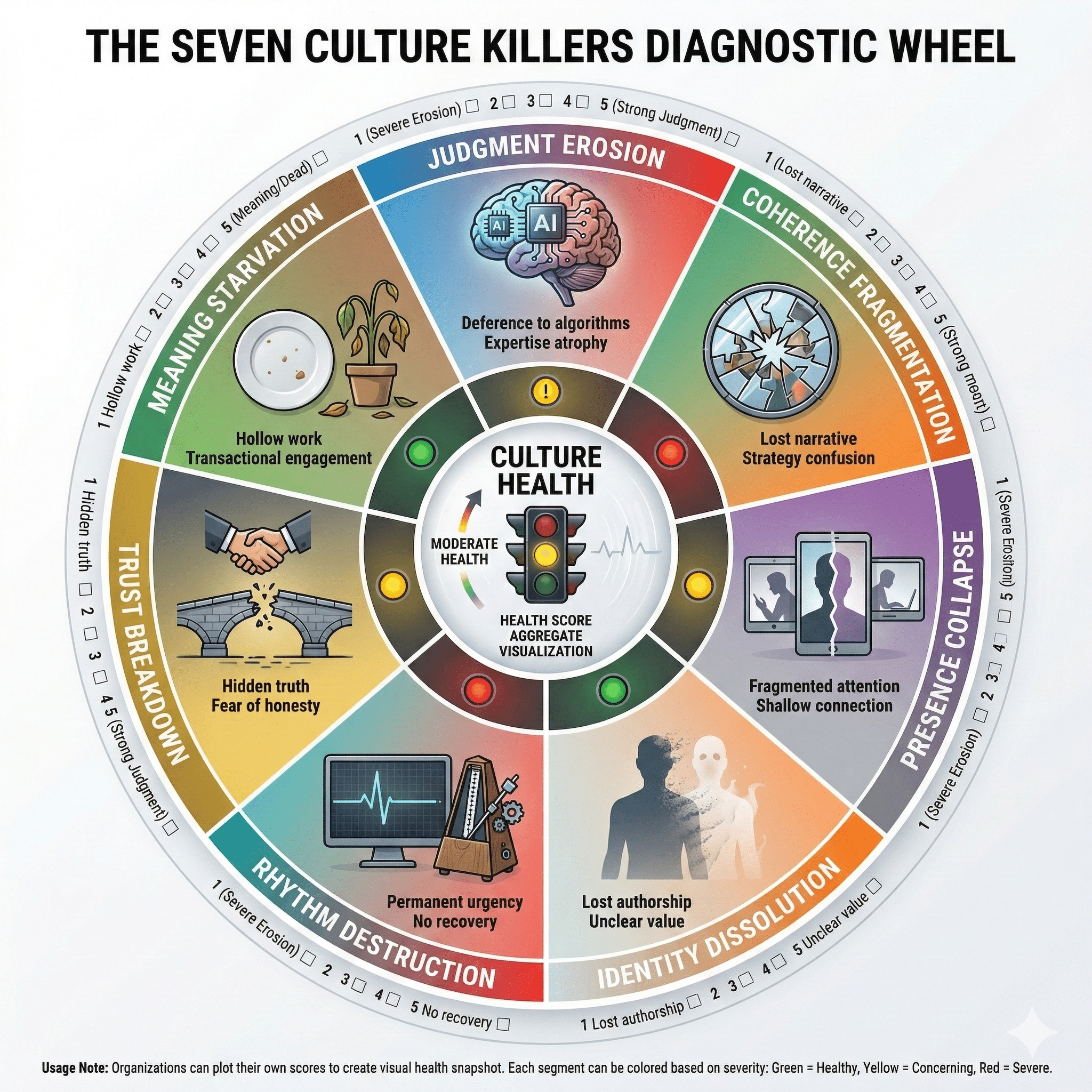
These seven patterns don't operate independently. They reinforce each other in destructive cycles:
- Judgment erosion undermines coherence (when people can't trust their thinking, meaning fragments)
- Coherence fragmentation destroys presence (when meaning is unclear, attention scatters)
- Presence collapse dissolves identity (when people aren't truly there, they lose sense of authorship)
- Identity dissolution breaks rhythm (when people don't know who they are, they work frantically)
- Rhythm destruction breaks trust (when everyone is depleted, safety disappears)
- Trust breakdown starves meaning (when you can't be honest, work becomes performance)
- Meaning starvation accelerates all patterns (when there's no purpose, everything deteriorates)
The good news: Addressing any one killer can create positive ripple effects across the system.
Diagnose Your Organization
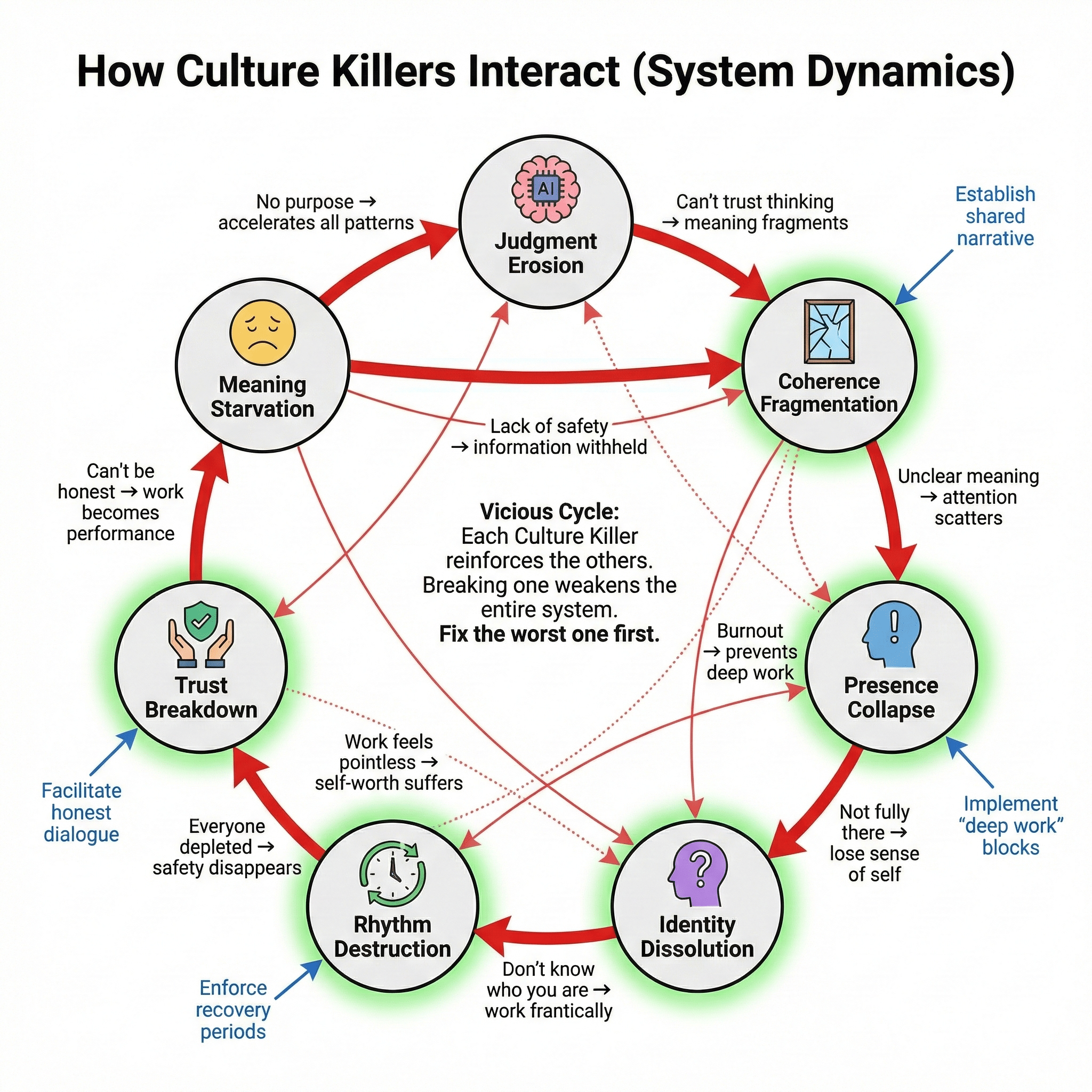
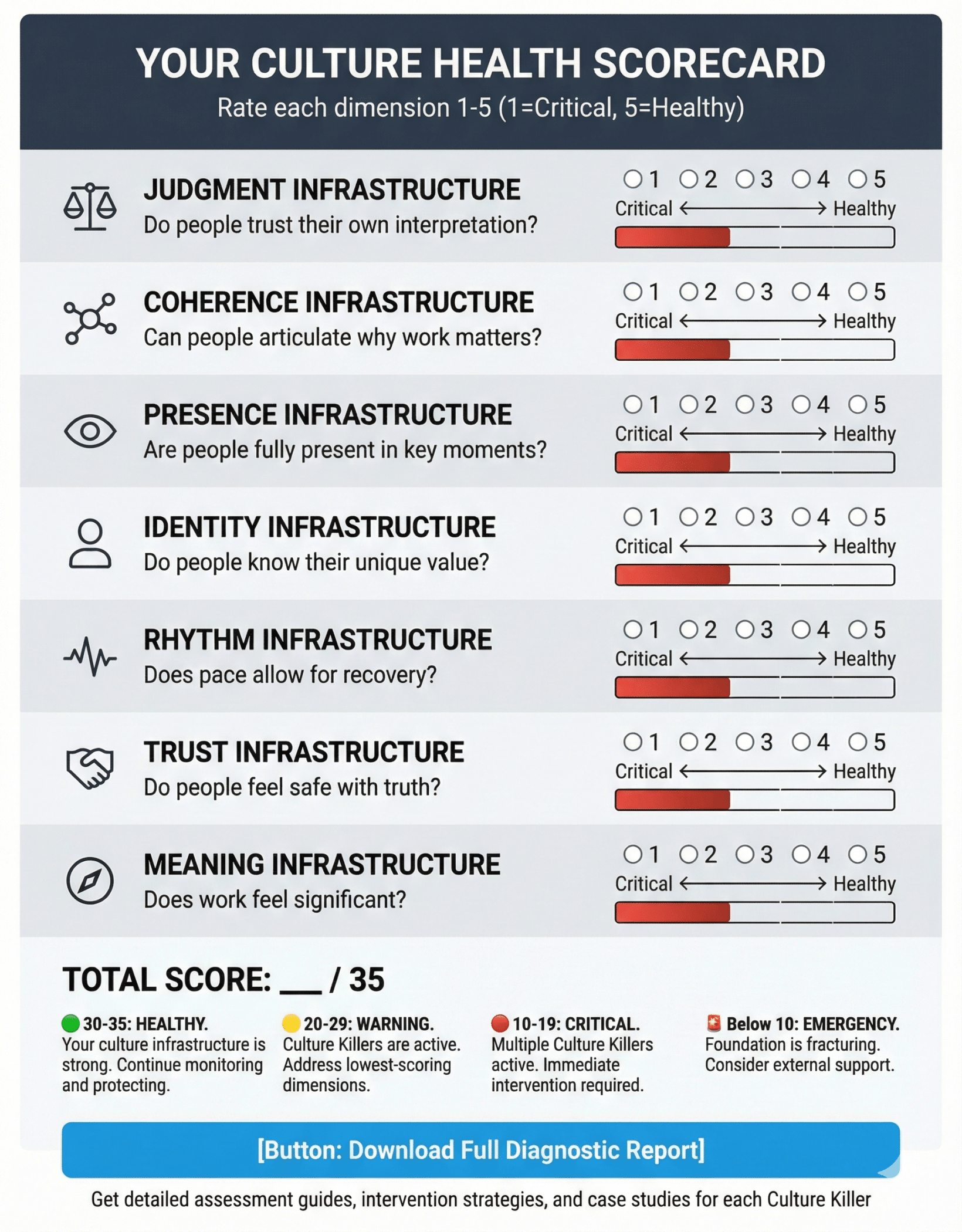
Rate your organization honestly on each Culture Killer (1 = severe problem, 5 = healthy):
1. Judgment Infrastructure: Do people trust their own interpretation, or defer automatically to systems?
☐ 1 ☐ 2 ☐ 3 ☐ 4 ☐ 5
2. Coherence Infrastructure: Can people articulate clearly how their work connects to purpose?
☐ 1 ☐ 2 ☐ 3 ☐ 4 ☐ 5
3. Presence Infrastructure: Are people fully present in interactions that matter?
☐ 1 ☐ 2 ☐ 3 ☐ 4 ☐ 5
4. Identity Infrastructure: Do people have clear sense of their unique, irreplaceable contribution?
☐ 1 ☐ 2 ☐ 3 ☐ 4 ☐ 5
5. Rhythm Infrastructure: Does organizational pace allow for recovery and integration?
☐ 1 ☐ 2 ☐ 3 ☐ 4 ☐ 5
6. Trust Infrastructure: Do people feel safe telling difficult truths?
☐ 1 ☐ 2 ☐ 3 ☐ 4 ☐ 5
7. Meaning Infrastructure: Does work feel significant, not just functional?
☐ 1 ☐ 2 ☐ 3 ☐ 4 ☐ 5
Your Score:
30-35 points: Your culture is healthy. Continue monitoring and protecting what's working.
20-29 points: Warning signs present. Some Culture Killers are active. Address the lowest-scoring dimensions first.
10-19 points: Critical state. Multiple Culture Killers are active. Immediate intervention is required.
Below 10 points: Cultural emergency. The foundation is fracturing. Consider bringing in external support to stabilize and rebuild.
What to Do Next
Cultural fractures don't heal themselves. They compound in silence.
If your score revealed Culture Killers at work in your organization, you have three options:
Option 1: Start small
Pick the single Culture Killer scoring lowest. Implement one fix this week. Cultural transformation doesn't require wholesale change—it requires consistent attention to what's eroding.
Option 2: Go deeper
Download the complete Culture Killers Diagnostic (free) for detailed assessment guides, intervention strategies, and case studies showing how organizations reversed each pattern.
Option 3: Get support
If multiple Culture Killers are active and you're not sure where to start, book a Heartware Health Check. We'll assess which patterns are most destructive in your specific context and create a prioritized action plan.
The Choice
Every organization is choosing right now, whether consciously or not:
Optimize for what you can measure easily (productivity, efficiency, output), or build capacity to measure what actually matters (judgment confidence, coherence, presence, identity, rhythm, trust, meaning).
The first path is simpler. Dashboards already exist. KPIs are established. You can show continuous improvement quarter after quarter.
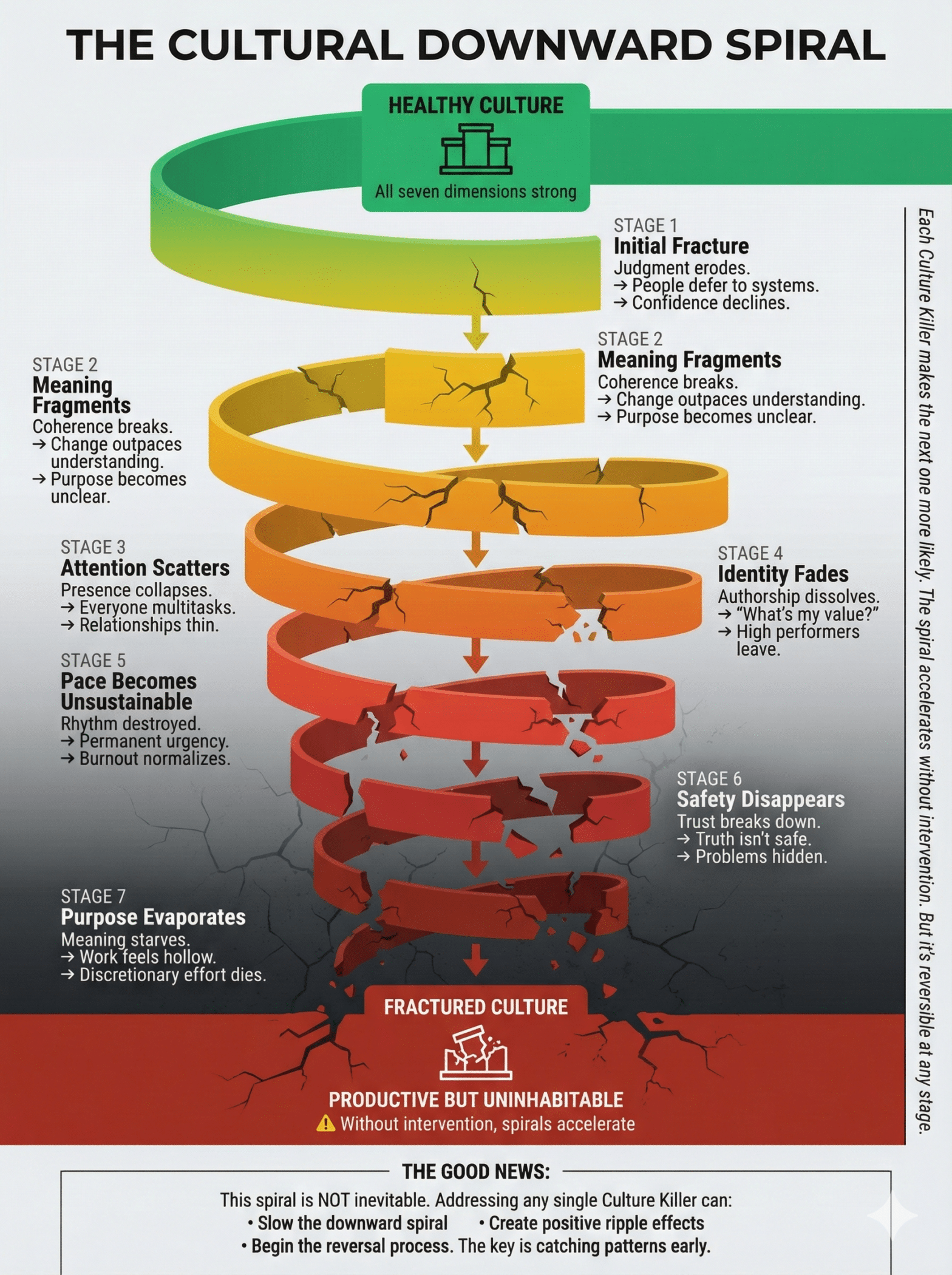
Until you can't. Until the invisible metrics you weren't tracking collapse. Until judgment confidence erodes past recovery. Until your top talent leaves without warning. Until the organization becomes productive and uninhabitable.
The second path is harder. It requires building new measurement systems. Training leaders to interpret qualitative signals. Making strategic decisions based on metrics that don't generate tidy bar charts.
But the second path is the only path that leads to sustainable transformation.
Culture fractures in silence. Healing begins with naming what's actually happening.
The question is whether you'll start before the Culture Killers become visible as an organizational crisis.
Share This
If this resonates, share it with leaders who sense something is wrong but can't quite name it.
Use the diagnostic with your team. Start the conversation about which Culture Killers you're seeing and what you're going to do about them.
The patterns are predictable. The damage is reversible. But only if you act while the fractures are still invisible.