
The Leadership Failure
Dashboards Will Never Show YOU
The Leadership Failure Dashboards Will Never Show YOU
“Acceleration doesn’t break organizations by making them slower or less capable. It breaks them by quietly eroding human judgment long before performance declines.”
This is a follow up post to "How Leadership Must Change in the Age of AI"
Most leadership failures in the age of AI do not announce themselves as failures.
On the surface, organizations often appear to be thriving. Decisions are made more quickly, output increases, and projects move forward. Dashboards show positive metrics, and from a distance, the company seems decisive, modern, and well-managed.
Yet beneath this apparent progress, a more fragile reality is developing—one that is often overlooked until it becomes a significant problem.
Employees begin to act without hesitation, not out of increased confidence, but because expressing doubt or pausing to reflect has become risky. As a result, judgment is exercised less openly, and while decisions are implemented efficiently, true ownership becomes increasingly rare. Over time, organizations do not necessarily lose their collective intelligence, but they do lose the crucial ability for individuals to interpret and stand behind decisions—a loss of what might be called interpretive authority.
This is the leadership failure most dashboards will never show.
The Illusion of Strength
The rapid pace of change can create a powerful illusion that simply moving faster equates to organizational health.
AI intensifies this illusion. When answers arrive instantly, when recommendations sound confident, when analysis is always available, leaders can mistake velocity for clarity. Teams appear aligned because they are no longer arguing. Meetings appear efficient because fewer people object. Execution improves because ambiguity has been compressed.
However, when alignment occurs without genuine understanding or interpretation, it is not true alignment at all. It is merely compliance.
In many organizations, what looks like confidence is actually a subtle withdrawal. Employees follow recommendations or outputs they do not fully trust, suppressing their own insights because they feel unable to challenge the authority of automated systems. Decision-making becomes something imposed upon them, rather than a process in which they are active participants.
The systems continue to function as intended, but the people within the organization become increasingly disengaged.
What Breaks First Is Not Performance
Leaders often assume that when things go wrong, performance will be the first signal.
This assumption no longer holds true in today’s environment.
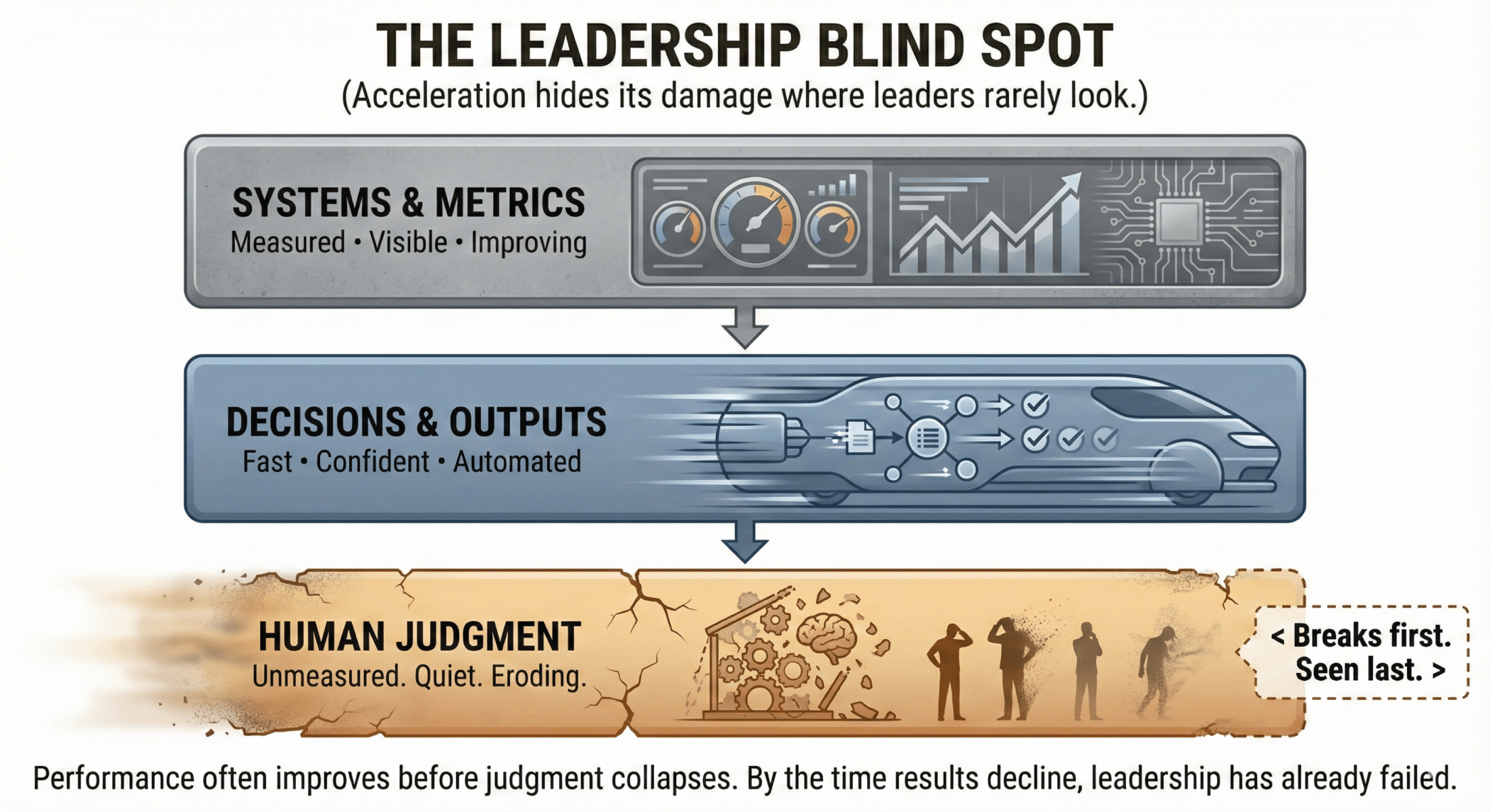
In accelerated environments, performance frequently improves before judgment collapses. AI tools enable greater output with less deliberation. Errors are caught earlier. Inefficiencies are optimized away. On paper, this appears to be progress.
What erodes first is not outward confidence, but the internal assurance individuals have in their own ability to make sense of complex situations. This is the type of confidence that enables someone to raise concerns, challenge recommendations, or point out when something does not seem right.
When this internal confidence diminishes, employees may continue to perform their tasks but no longer take genuine ownership of their work.
Leadership often misses this because the signals are subtle:
- Fewer questions, not better ones
- Faster decisions, but thinner discussion
- Agreement that arrives too easily
- Silence mistaken for alignment
By the time performance metrics begin to decline, the most significant loss—the erosion of judgment and ownership—has already occurred.
Why Leaders Misread the Moment
Most leaders were trained in a world where intelligence was scarce, and ambiguity slowed action. In that world, asking the right questions helped organizations converge on better answers. Inquiry created orientation.
AI fundamentally alters how answers are generated and presented within organizations.
Today, questions no longer narrow the field by default. They often open it. A single prompt can produce multiple plausible paths, each delivered with confidence and speed. Inquiry accelerates complexity instead of containing it.
Leaders may continue to ask thoughtful questions yet inadvertently destabilize their organizations because automated systems now provide answers more quickly than people can fully process or interpret.
This creates a dangerous mismatch:
- Answers arrive before interpretation forms
- Clarity appears before judgment stabilizes
- Action begins before ownership exists
Leaders may lose control over how answers are produced and disseminated, but they remain responsible for the impact those answers have on their teams and organizations.
This ongoing responsibility is now one of the most challenging aspects of leadership.
The Cost of Deference
When acceleration outpaces interpretation, people begin to defer—not because they believe the system is always right, but because challenging it feels risky, slow, or futile.
From an external perspective, deference may appear to be trust in the system, but internally it often entails a gradual erosion of individual agency and confidence.
People start to doubt themselves:
- “The model must know more than I do.”
- “If this is wrong, someone else will catch it.”
- “I don’t have time to push back.”
Judgment does not vanish; instead, it becomes hidden and unexpressed within the organization.
This is why failures in AI-rich environments often feel shocking in retrospect. The signals were present, but no one felt authorized to act on them. Human judgment was available—but socially inaccessible.
The increased pace of decision-making has not eliminated responsibility; rather, it has dispersed it so widely that it becomes difficult for anyone to identify who is truly accountable.
Leadership Is No Longer About Moving Through Ambiguity
For years, leadership advice emphasized the ability to lead through ambiguity. That was sound guidance in a slower world, where ambiguity resisted resolution and required patience.
However, the nature of ambiguity itself has changed in the current environment.
While some ambiguity continues to drive exploration and learning, other forms now overwhelm people’s ability to make sense of information when they arise too rapidly. The challenge for leaders is no longer to navigate uncertainty, but to manage the speed at which it arrives.
In the age of AI, leadership is not a choice between action and hesitation. It is the discipline of knowing:
- Which uncertainties must be resolved quickly
- Which uncertainties must be held longer
- And which forms of clarity are arriving too fast to be trustworthy
This approach is not a sign of indecision, but rather an act of stewardship—ensuring that decisions are made thoughtfully and responsibly.
The Quiet Work Leaders Must Do Now
Today, some of the most important work leaders do may not appear impressive or dramatic.
It occurs when a leader delays a decision that appears obvious because the team has not yet metabolized its implications, when they legitimize doubt rather than smoothing it over, and when they insist on interpretation before execution.
It happens when leaders protect the space where people are still forming judgment—before dashboards, recommendations, or consensus harden prematurely.
This type of leadership does not scale easily, is rarely captured by traditional metrics, and often goes unnoticed.
Yet it is precisely this work that determines whether organizations retain the capacity for genuine judgment, or simply go through the motions of competence without true understanding.
What Is at Stake
AI will continue to accelerate. That is not a choice.
The question is whether organizations allow acceleration to hollow out human judgment quietly, or whether leaders take responsibility for the internal conditions under which decisions are made.
The future of leadership will not be defined by who moves fastest, adopts earliest, or automates most aggressively.
It will be defined by leaders who understand when to slow down the process of making meaning, ensuring that decisions are truly understood before they are acted upon.
When judgment fails, systems may continue to operate, but the essence of effective leadership is lost.
By the time these failures become visible in organizational outcomes, the most important losses—those of judgment and ownership—have already taken place.