
Your Boss Is a Machine.
Now What?
Your Boss Is a Machine. Now What?
How to maintain judgment, agency, and meaning when algorithms mediate your work life
You have the benefit of being critiqued by someone who is observing you at work, appreciates the general background of the situation at hand, and, while delivering unpleasant news, knows to keep it upbeat.
Now, instead, you get a dashboard notification. Maybe a pop-up, maybe a number turning red. No conversation, just a signal from a heartless AI.
Your priorities? Not agreed to in a conversation with your human manager anymore. Instead, an AI generates them, optimizing for metrics you probably don’t know about.
Your pace? Not negotiated with a boss who knows that you just worked three late nights. It’s now dictated by an AI that measures only productivity, not exhaustion, not context, and not any other human metric that relates to well-being.
Your boss is steadily becoming a machine.
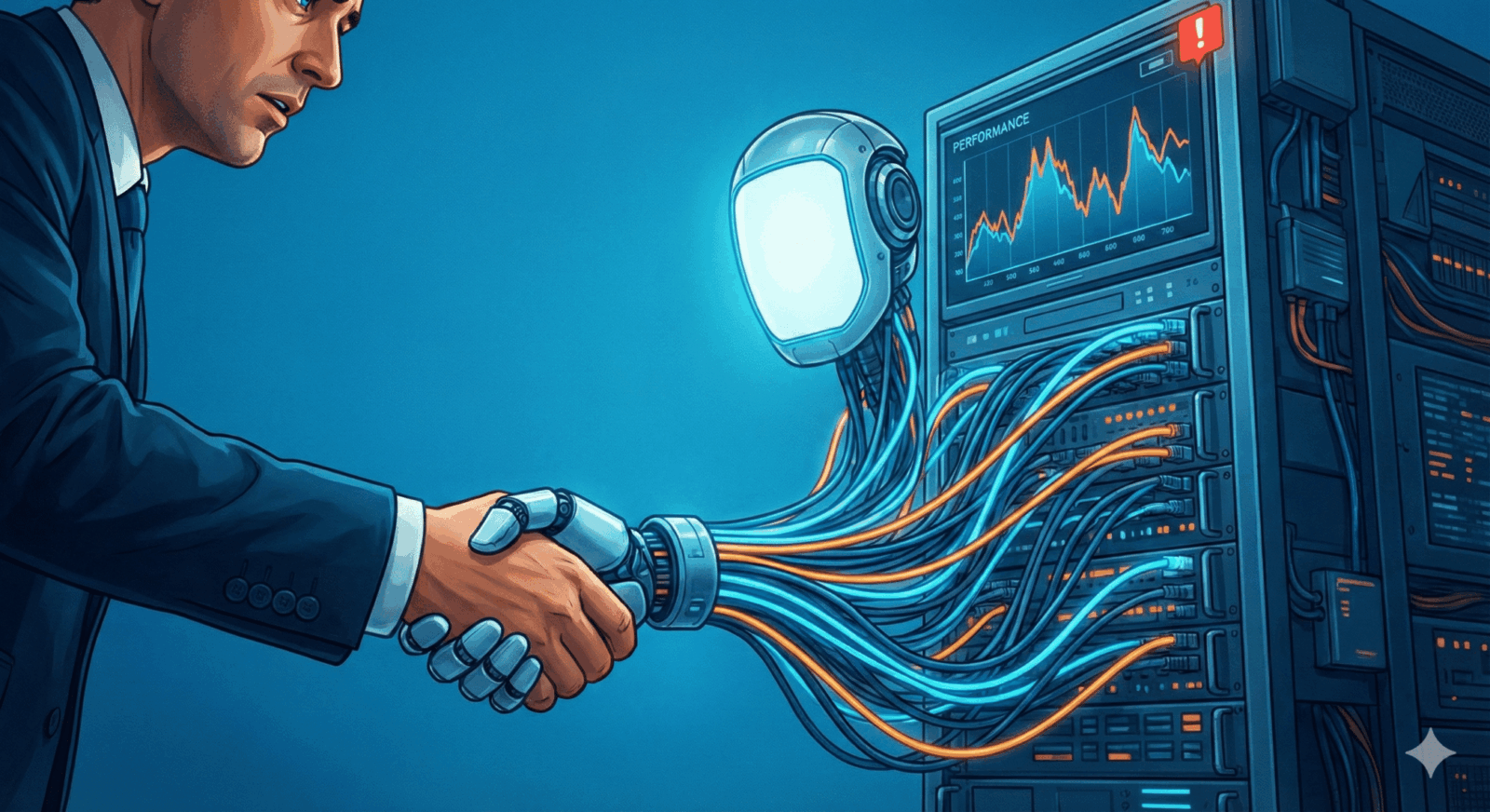
Is that progress?
Or not?
This isn’t some distant science fiction scenario. For many people, it’s just another workday.
Maybe it’s already your reality.
What "Machine Boss" Actually Means
Look, your human manager probably still exists. They run your 1:1s, approve your time off, write your review.
But the decisions that actually shape your day?
Those are algorithmic now:
- Which tasks hit your queue and in what order
- How your performance is measured and scored
- What pace is considered "acceptable"
- Which of your work products gets flagged for review
- How your time is categorized and valued
The human manager might still interpret and communicate. But the machine is making the decisions.
So now you report to a person, but that person also reports to a system. When human judgment and the algorithm disagree, which one wins? Usually, the algorithm.
"The system flagged this." "The data says otherwise." "I don't make the rules."
Sounds familiar? Most likely.
Many employees are experiencing this right now.
The Three Losses
When a machine effectively becomes your boss, three things tend to erode. Most people don’t even notice it happening.
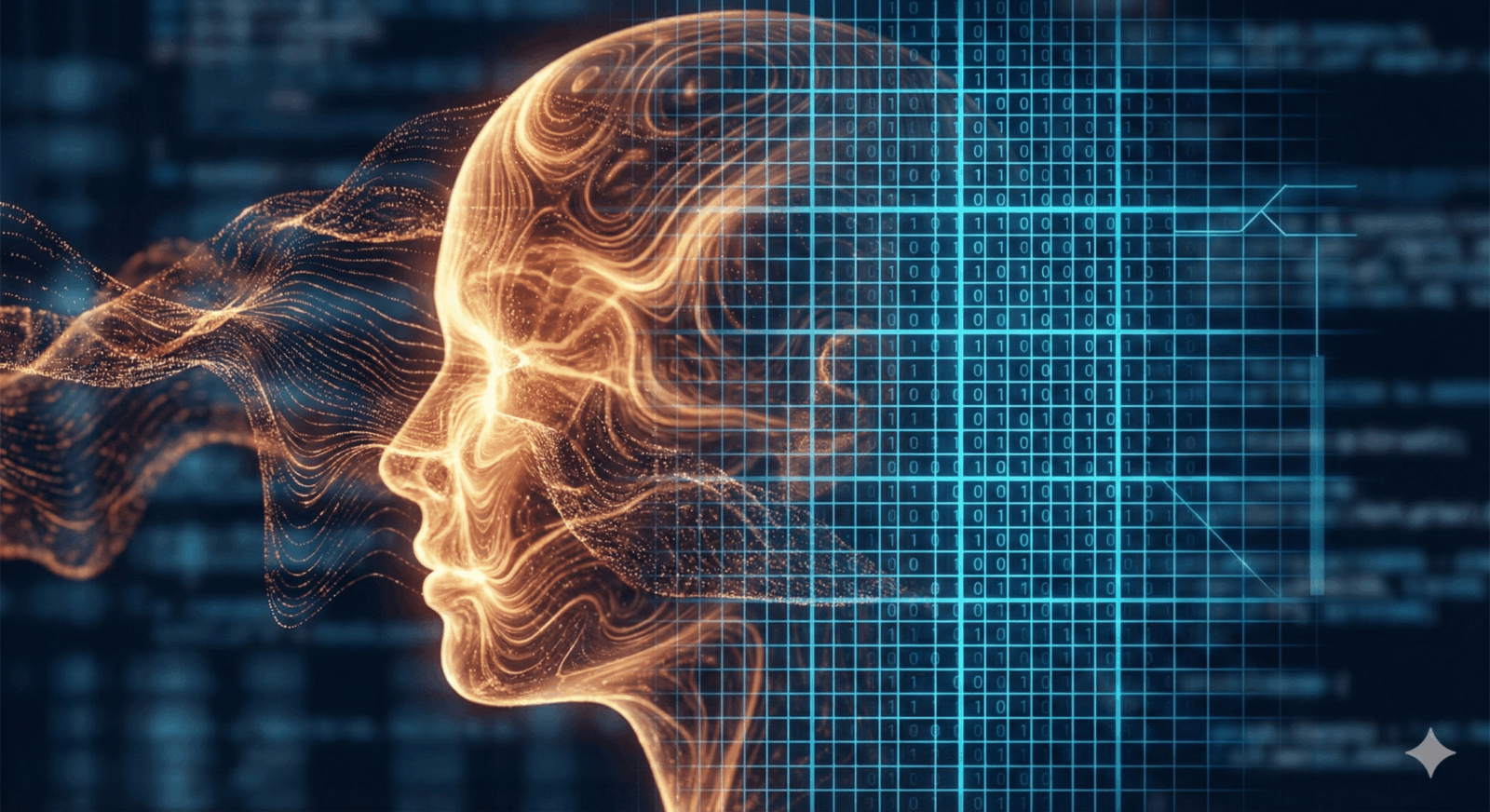
1. Loss of Contextual Judgment
A human boss might notice that your performance dipped because you spent two weeks onboarding a struggling colleague.
AI sees underperformance.
A human boss might know that your "slow" response time was caused by the fact that you were tackling a really complex problem.
AI sees inefficiency.
Over time, people stop using judgment that the system can’t see or reward. They optimize for what’s measured. The rest—innovation, critical thinking, and creative risk-taking—all start to go by the wayside.
This is Judgment Erosion. Defer to the AI long enough, and you'll forget you know anything it doesn't.
2. Loss of Sustainable Rhythm
Your human bosses get tired. They take vacations. They have good and bad days. Their expectations change depending on current realities.
You know what never takes a day off? The AI that sets your workload.
You've been up since 2am with a sick kid. You're exhausted.
Doesn't matter—same targets.
Your dad died last month, and you're barely holding it together.
Doesn't matter—same pace.
Three people quit, and you're covering their work. Still doesn't matter.
The system sees a number. You either hit it or you don't.
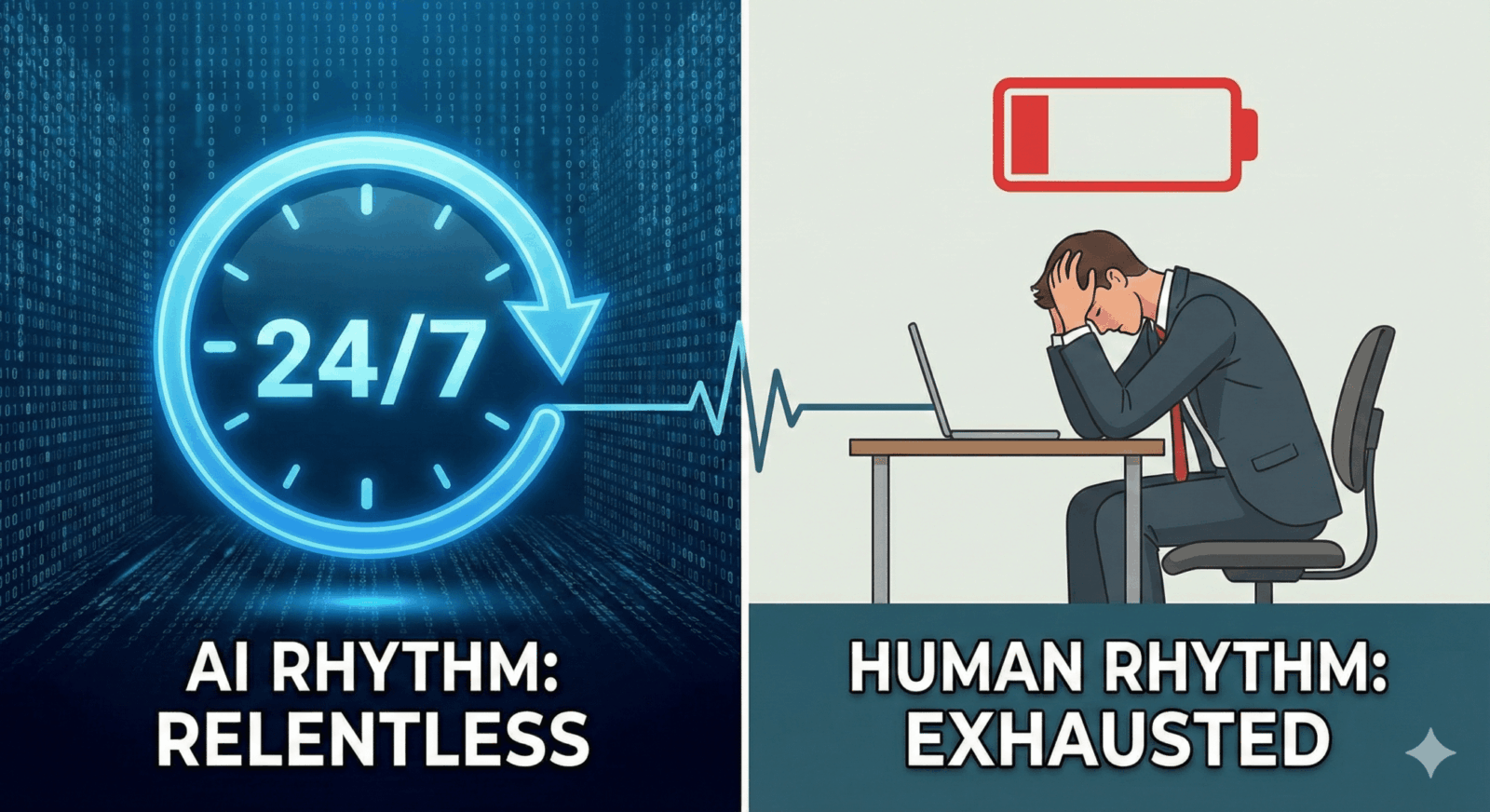
This is Rhythm Destruction. There's no you-time built into AI because whoever designed it didn't think to model it.
Instead, they modeled performance, productivity, and output. Things that can easily be measured and modeled.
You've been up since 2am with a sick kid. You're exhausted.
Doesn't matter—same targets.
Your dad died last month, and you're barely holding it together.
Doesn't matter—same pace.
Three people quit, and you're covering their work. Still doesn't matter.
The system sees a number. You either hit it or you don't.
This is Rhythm Destruction. There's no you-time built into AI because whoever designed it didn't think to model it.
Instead, they modeled performance, productivity, and output. Things that can easily be measured and modeled.
And when you finally crash.
And you will.
Guess whose fault that will be?
Obviously.
Yours.
3. Loss of Narrative Identity
My old boss saw me bomb my first client presentation. I mean, really bomb. I forgot the client's name halfway through. But she also saw me turn it around.
The same client asked for me by name two years later, and she remembered that, too.
She kept the whole story in her head.
Nobody's dashboard is going to remember that.
Ten good years mean nothing if Q3 was bad. Q3 is what's on the screen right now.
Next quarter, it resets again. You never build anything.
You're reduced to a bunch of numbers in a dashboard.
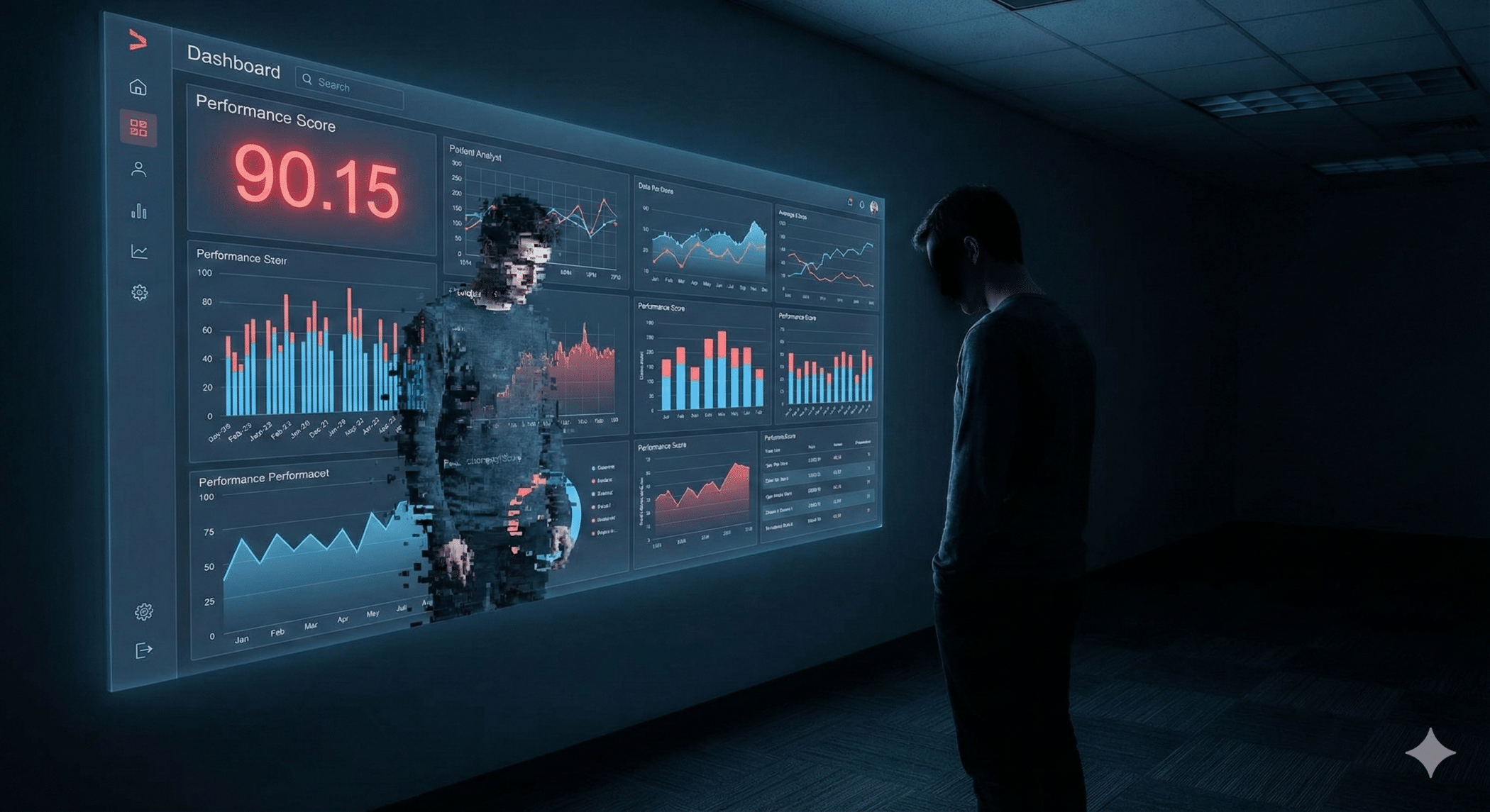
That's it.
That's your job now.
At some point, not sure when, month six? Maybe month eighteen?
You wonder: wait, what the hell am I actually doing here?
Am I building something?
Or am I just... fodder for a dashboard?
This is Identity Dissolution. You used to feel like a professional. Now you feel like a row in a spreadsheet. And the worst part is you can't remember exactly when that changed.
The Trap: Blaming the Human in the Middle. Who do you even get mad at?
That's the part that makes you crazy.
Something's wrong, so you go to your manager. "Why is my workload insane right now?" And she just shrugs. "That's what the system allocated."
What are you supposed to do with that?
"Why did I get flagged for that?" Your manager checks: "The AI told me so."
Your human manager becomes the translator of AI decisions they did not make and often cannot override. They deal wth your frustration without having the authority to address the real source.
Meanwhile, the system—the real decision-maker—remains invisible, unaccountable, and hard to challenge.
This isn't your manager's fault—they may have no more power over the algorithm than you do. But somewhere in your organization, someone chose to implement these systems.
Someone chose how much human discretion to allow. And every time a leader says "the system says" without questioning whether the system should say that, they're choosing to let the machine decide.
Now What?
If this is the world you live in, you have three options:
Option 1: Optimize for the AI
Figure out what the AI rewards. Optimize for those metrics. Don’t spend energy on things that aren’t tracked by the AI.
This approach can work temporarily. But in the long term, it will prove destructive. You get good at gaming the system, but the things you have to offer that aren't part of that behavior will start to hurt.
Option 2: Fight the Machine
Push back. Document where the system fails. Advocate for human judgment. Refuse to bow down to the AI when it doesn’t make sense.
The method has great value, but it requires significant effort to maintain. The extent of your career advancement in this case depends on your organization's capacity to handle employee disagreements.
Option 3: Build Your Own Infrastructure
This is maybe the hardest path to embark on, but it is most likely the most sustainable.
You may not control how your company uses AI.
But you can control your own judgment, rhythm, and core identity.
- Judgment: Keep your own notes. When your gut says one thing and the algorithm says another, write it down. Track what actually happens. Don't let the system be the only record of what's true.
- Rhythm: Block sufficient time for lunch. Build time in between meetings. Make time to think and reflect. Take the weekend off. Get home for dinner with your family. Just because the AI never stops doesn't mean you shouldn't.
- Identity: Write it down. The projects you're proud of. The people you helped. The problems you solved. If you don't keep the record, the dashboard becomes the only story.
This isn’t a sustainable solution, but a survival strategy. The real solution would require organizational change; building what we call 'heartware™,' or the emotional infrastructure that lets people stay whole inside accelerating systems.
But that's bigger than one blog post.
The Question Behind the Question
So yeah. The boss thing is just the surface.
The real question — and we're still working on this — is whether you can stay inside these systems and come out the other side intact. Still trusting your gut. Still knowing who you are. Still believing the work adds up to something.
We built the Culture Killers framework because we got tired of spinning on this question alone.
Download the Culture Killers Field Guide by entering your email below.
Share This
If this resonates, share it with leaders who sense something is wrong but can't quite name it.
Use the diagnostic with your team. Start the conversation about which Culture Killers you're seeing and what you're going to do about them.
The patterns are predictable. The damage is reversible. But only if you act while the fractures are still invisible.